
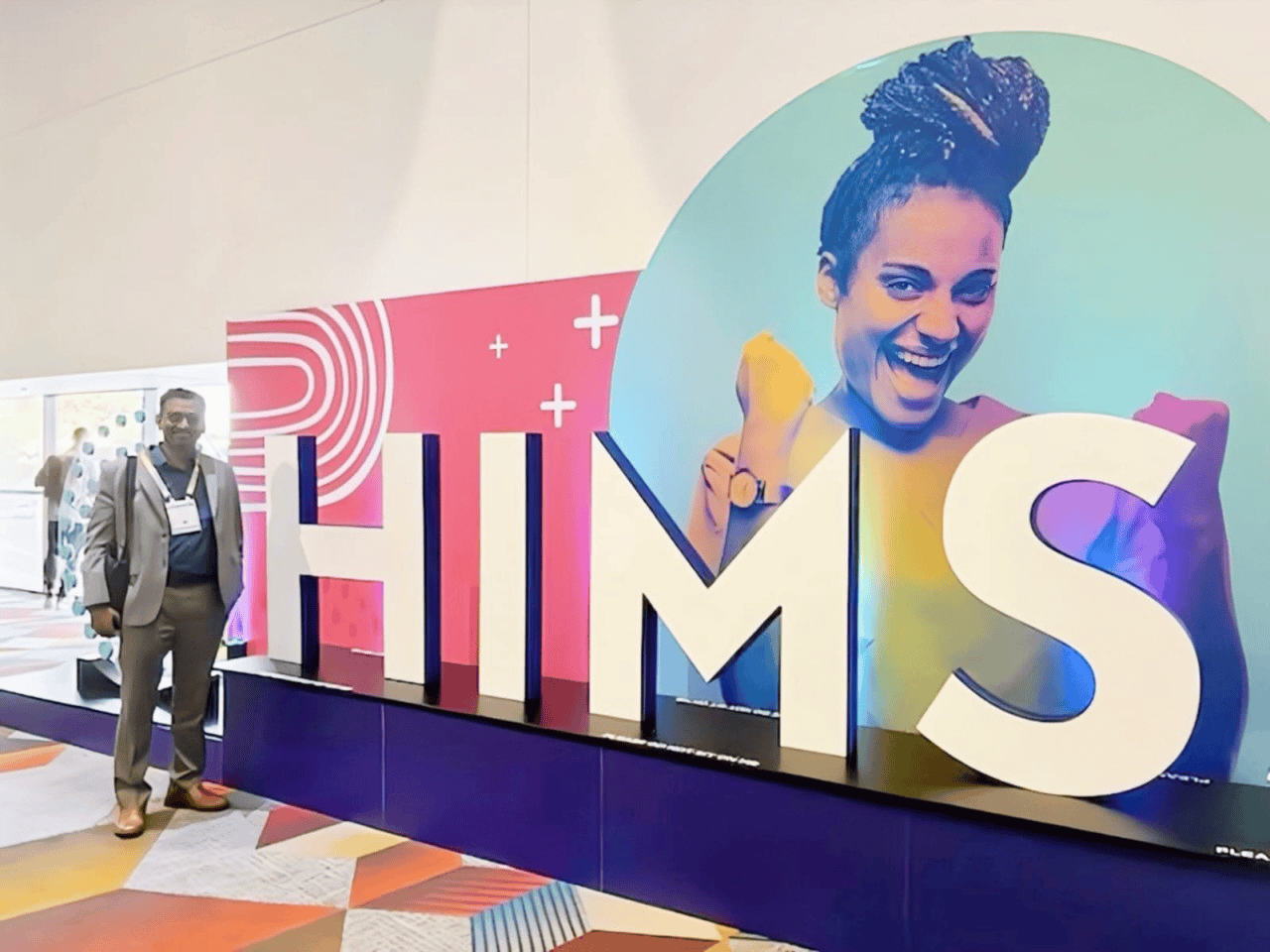
After spending time at HIMSS 2026, I came back with a familiar feeling – the same one I had after ViVE earlier this year.
Almost every conversation begins with “we’re building something with AI…”.
But somewhere between the sessions, the hallway conversations, and the endless demos, one question kept coming back to me:
How much of this is actually translating into execution?
Because after everything I saw and heard, I’m not sure we have an ideas problem.
I do think the execution is questionable.
First, Let’s Acknowledge This
HIMSS is not just another conference.
It’s what happens when the entire healthcare ecosystem decides to show up in one place at the same time.
You have health systems trying to modernize, startups trying to disrupt, large enterprises trying to scale, and vendors trying to explain – very convincingly – why their solution is the missing piece.
And to be fair, the energy is real.
There is intent. There is urgency. There is investment.
But when you operate at this scale, something interesting happens.
You start seeing patterns.
Not just in what people are building.
But in how they talk about what they’re building.
The Biggest Shift: AI Is No Longer a Debate
Let’s get this out of the way.
AI has officially moved past the “should we use it?” phase.
That conversation is over.
At HIMSS 2026, the discussion has clearly shifted to:
- How do we make it work in real workflows?
- How do we trust it?
- How do we scale it beyond pilots?
- How do we measure ROI?
And this is a good thing.
You could see it in sessions like Gary Fingerhut , Kore.ai where he walked through real deployments of agentic applications across scheduling, billing, and care navigation.
Not experiments.
Actual systems driving measurable outcomes.
Or Dr. Alexander Jarasch discussion on Neo4j knowledge graphs – turning fragmented healthcare data into something that actually resembles a patient journey instead of a collection of disconnected records.
And one line from Etienne Soulard-Geoffrion stayed with me:
“AI doesn’t need more data. It needs better memory.”
If you’ve worked in healthcare data, you felt that.
But Here’s What Hasn’t Changed (And This Is Important)
Despite all the progress…
We are still very good at talking about the problem.
And slightly less good at explaining what actually worked.
Many sessions followed a familiar pattern:
- Here’s the problem
- Here’s the opportunity
- Here’s the vision
And then…
We move on.
What’s often missing:
- What did you actually build?
- What broke?
- What failed?
- What did you have to compromise?
- Would you do it the same way again?
At times, it felt like watching a movie trailer on loop.
Great storytelling.
Very little behind-the-scenes.
And in healthcare, the behind-the-scenes is where all the value is.
Interoperability: Technically Better, Practically… Complicated
There is no doubt that interoperability has improved.
Standards like HL7 and FHIR are doing what they were designed to do – enabling systems to exchange data more effectively.
The demonstration around chronic care – integrating EMS, EHRs, home monitoring, imaging, and public health – was a great example of how far we’ve come.
But there’s still a gap.
Because data exchange is not the same as data usability.
Just because information flows between systems does not mean it is:
- Contextualized
- Actionable
- Useful at the point of care
And that distinction is critical.
Because data without context is just… faster confusion.
The Real Bottleneck: It’s Not the Technology
Multiple sessions, same underlying theme.
AI is not struggling because of algorithms.
It’s struggling because of everything around it.
In the session led by Cheryl Denison BSN, RN, NI-BC and Tracy Breece, MSN, RN, CENP, NI-BC, CPHIMS , the focus was on nursing adoption of AI.
And the takeaway was simple – if users are not confident in the system, adoption will fail.
No matter how advanced the solution is.
Similarly, Cecilia Edwards spoke about why AI initiatives often stall after successful pilots.
The issue is rarely technical.
- It’s organizational.
- Misaligned incentives
- Lack of ownership
- Weak governance
- Limited trust
These are not problems you solve with better models.
These are problems you solve with better systems of work.
Agentic AI: Powerful… But Needs Control
There was a lot of excitement around agentic AI.
Systems that don’t just assist – but act.
Benjamin Cushing presented an approach that adds a deterministic layer to these systems – essentially making their decisions traceable and structured.
Which is important.
Because healthcare is already complex and unpredictable.
Adding opaque, non-deterministic systems into that environment without guardrails is not innovation.
It’s instability.
The goal is not just intelligence.
It’s controlled, accountable intelligence.
A Session More People Should Have Attended
One of the more grounded sessions was led byMichelle Jump, focusing on medical device cybersecurity.
What stood out was how non-technical the core problem actually is.
When a vulnerability is identified, the biggest issue is coordination.
- Who is responsible?
- Who communicates what?
- How quickly can action be taken?
Hospitals and manufacturers often operate on different timelines, with different expectations.
And in that gap, risk grows.
It’s a reminder that healthcare transformation is not just about building new systems.
It’s also about managing complexity across existing ones.
HIMSS Scheduling: A High-Class Problem
At one point, I had to choose between three sessions:
- Scaling AI in healthcare
- Expanding access in safety-net systems
- Cybersecurity response coordination
All happening at the same time.
This is great… until you realize you can only be in one room.
You end up making decisions like you’re choosing a Netflix show.
“Which one will I regret missing less?”
Where the Real Value Actually Happens
Interestingly, the most valuable insights didn’t always come from the sessions themselves.
They came from conversations outside them.
Hallways. Coffee breaks. Quick catch-ups.
That’s where people stop presenting… and start being honest.
Conversations like:
- “We tried AI. It worked in pilot. Then everything broke at scale.”
- “Integration took 6 months longer than expected.”
- “The hardest part wasn’t tech. It was getting teams aligned.”
No slides. No buzzwords.
Just reality.
And honestly – that’s where the real learning happens.
So… Where Does That Leave Us?
HIMSS 2026 shows progress.
Real progress.
- AI is moving into workflows
- Interoperability is improving
- Organizations are thinking seriously about scale and trust
But we’re also at an inflection point.
Because the next phase of healthcare transformation is not about ideas.
It’s about execution.
And execution is messy.
Which is exactly why we don’t talk about it enough.
If I Could Change One Thing
It would be this:
Less “what’s possible.”
More “what actually worked.”
And more importantly:
What didn’t.
Because that’s where the real value is.
Let Me Leave You With This
If you attended HIMSS this year, I’m curious:
What is one thing you saw that is actually working in production today?
Not a pilot.
Not a concept.
Something real.
Drop it in the comments — would genuinely like to hear different perspectives.
Because if we can collectively shift the conversation toward execution…
That’s when real progress starts to happen.

Discover more from Sudhakar's Musings
Subscribe to get the latest posts sent to your email.