
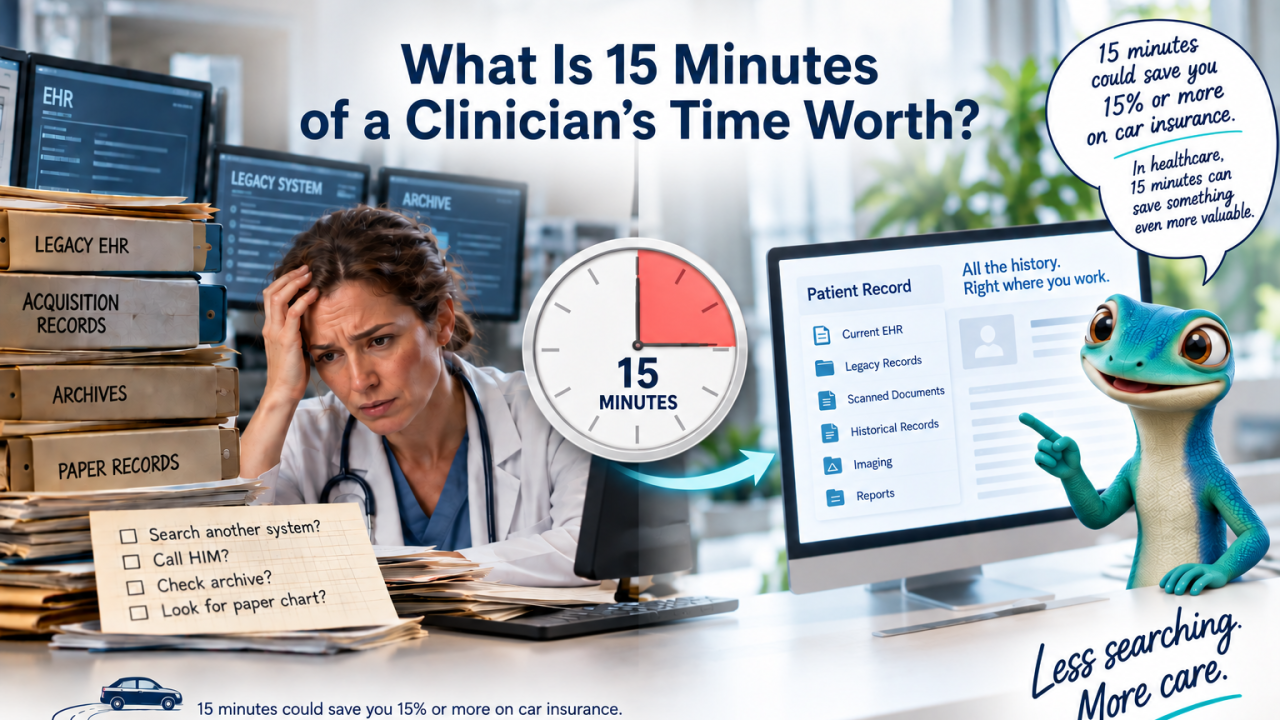
Healthcare has spent billions trying to make patient information easier to access. Yet clinicians still spend valuable time searching for information – even what their organization already has.

The 15-Minute Problem
Imagine a physician seeing a patient and needing an old procedure note.
It isn’t in the current chart.
The physician searches. Maybe asks someone. Perhaps logs into another system. Maybe calls HIM. Someone else searches an archive. Eventually, the document is found.
Let’s say the whole exercise takes 15 minutes.
Fifteen minutes doesn’t sound like much.
GEICO has spent years telling us that 15 minutes could save you 15% or more on car insurance. Apparently, in healthcare, 15 minutes can cost us quite a bit more.
Because healthcare math changes dramatically when you start multiplying.
Fifteen minutes × hundreds of clinicians × thousands of patients × 250 working days.
Suddenly, 15 minutes isn’t a minor workflow inconvenience.
It is capacity.
We talk constantly about physician burnout, staffing shortages and access to care. We invest in sophisticated technologies designed to make clinicians more productive.
Sometimes there is a much simpler opportunity:
Give clinicians their time back by stopping them from searching for information the organization already has.
The Irony of EHR Consolidation
So why are clinicians still searching?
Over the last couple of decades, healthcare organizations have spent billions consolidating EHRs. They have moved from dozens of systems to a few strategic platforms. Hospitals have standardized, health systems have acquired other hospitals, and old systems have been retired.
But there is an interesting irony here.
We have done a reasonably good job of consolidating systems.
We haven’t necessarily consolidated the patient’s history.
Some of it is in the current EHR. Some may be sitting in a retired legacy system. Some came from a hospital acquired ten years ago. And some may still be on paper.
If a health system moved to Epic five years ago, the patient did not suddenly become five years old.
A 65-year-old patient may have decades of medical history that existed long before the current EHR. Procedures, diagnoses, medications, imaging, lab results and physician notes don’t become irrelevant simply because the system that originally stored them was retired.
The technology may be legacy.
The patient’s history isn’t.
For IT, this is a data problem.
For the clinician, it is a time problem.
And this problem becomes even more interesting as we start using AI to summarize records, support clinical decisions and predict outcomes. AI can only work with the information it can see.
Customers Aren’t Asking for Another System
This is something I have heard repeatedly from healthcare organizations.
They don’t want another application.
They don’t want another repository.
And they certainly don’t want clinicians logging into yet another legacy system.
A Senior Director of Information Technology described the challenge well:
“A significant challenge we encountered was maintaining access to historical patient data. It was essential that physicians could easily retrieve legacy records without disrupting their clinical workflow.”
That last phrase is important:
Without disrupting their clinical workflow.
Because technically making information available is not the same as making it useful.
One Click Is Better Than One More Login
This is where I think the design philosophy matters.
With Access Unify | Health, historical information from retired systems can be brought together and made available from within the clinician’s existing workflow.
For example, in Epic, a clinician can launch directly from the patient chart into the historical information for that same patient.
No separate patient search. No hunting through another application. No figuring out which old system contains the record.
Fifteen minutes of searching can become one click.
That is a very different way to think about technology. The value isn’t necessarily another feature on the screen. The value may be the steps that disappeared.
And Then There Is Paper
Electronic records are only part of the problem.
Many healthcare organizations still have significant physical record inventories. Those records may contain clinically relevant information, but accessing them traditionally means finding the box, retrieving the chart, locating the right page and somehow getting that information back to the person who requested it.
Again, the problem is not simply storage. It is time.
One approach is to index physical records alongside electronic records and digitize the relevant documents when they are actually needed.
A HIM Manager at a Community Health system described the impact of this kind of access:
“We had years of paper records along with electronic records from our legacy systems. Access offered a smart combination—bringing our physical and digital records together in Access Unify® | Health and making them accessible through a direct link in Meditech.”
Don’t make people go looking for information if technology can bring the information to them.
Maybe We Are Measuring Technology the Wrong Way
Healthcare technology is usually measured in familiar ways.
ROI. Cost savings. Productivity. Adoption. Revenue. System uptime.
All useful measures. But perhaps we should add another one:
Minutes returned.How many minutes did the physician not spend searching?
How many minutes did HIM not spend retrieving?
How many minutes did IT not spend keeping an old application alive simply because someone might need a record from 2009?
And perhaps most importantly, how many minutes did the patient not spend waiting while everyone else searched?
One minute doesn’t sound impressive in a business case. Neither does five.
Even fifteen may not. Until you multiply those minutes across thousands of people and millions of interactions.
Then minutes become hours. Hours become capacity. And capacity becomes better access to care.
The Best Technology May Be the Technology You Don’t Notice
We often associate innovation with adding things.
More AI. More applications. More dashboards. More features.
But sometimes innovation is subtraction.
One less login.
One less search.
One less phone call.
One less legacy application.
One less 15-minute detour.
The best healthcare technology may not be the technology that makes clinicians say, “Look at this amazing new system.”
It may be the technology they barely notice because the information they need is simply there when they need it.
So perhaps when we evaluate the next healthcare technology investment, in addition to asking about ROI, features and implementation timelines, we should ask one more question:
How many minutes will this give back?
Discover more from Sudhakar's Musings
Subscribe to get the latest posts sent to your email.