
Imagine you’re driving home after a long day. You’re following every traffic rule, staying within the speed limit, and paying attention to the road. Suddenly, the brakes fail.
Thankfully, nobody is hurt. But then someone tells you that you are entirely responsible because you were behind the wheel!
That would sound unreasonable, wouldn’t it? Yet that is surprisingly close to the conversation we are beginning to have around AI in healthcare.

Over the past two years, I have watched ambient AI documentation move from conference demos to real clinical workflows. Physicians are using AI to listen to patient conversations, generate clinical notes, suggest diagnoses, and even assist with coding and documentation. In many organizations, AI is no longer a pilot project. It is becoming part of the infrastructure of care delivery. And that raises a question that is both simple and uncomfortable:
If AI makes a mistake, who owns it?
The physician? The hospital? The vendor that built the software?
I’ve been following this debate closely, especially after recent discussions around documentation errors generated by ambient AI systems. The more I think about it, the more I believe we are asking the wrong question.
The real question is not “Who can we blame after the error?”
The real question is
“How should accountability evolve when software becomes part of clinical decision-making?”
The temptation to blame the clinician
A recent discussion about ambient AI documentation errors caught my attention. The underlying assumption in many conversations is that the physician remains responsible because the physician ultimately signs the note.
On the surface, that sounds reasonable. Clinicians should absolutely review and approve documentation that becomes part of the medical record.
But let’s pause for a moment.
Reviewing a note is very different from validating the inner workings of a complex AI system. A physician can verify whether a medication, diagnosis, or treatment plan is clinically appropriate. But should we also expect that physician to detect subtle transcription failures, context-loss errors, hallucinated details, or model drift introduced by a software update deployed last weekend?
That feels less like clinical responsibility and more like asking the pilot to inspect the aircraft engine mid-flight.
The car analogy matters
I keep coming back to the driving example because it separates two very different kinds of accountability.
If a driver is intoxicated and causes an accident, the responsibility is clearly the driver’s.
But if the steering system fails because of a manufacturing defect, we don’t say, “Well, someone was holding the wheel, so it must be their fault.” We investigate the vehicle, the design, the maintenance history, and the manufacturer.
Healthcare AI deserves the same distinction.
If a clinician ignores an obvious error, that is a professional responsibility issue.
But if an AI system introduces incorrect information, omits critical context, or behaves unpredictably because of a design or validation failure, the vendor cannot simply disappear behind a disclaimer that says, “For clinician review only.”
- Clinical judgment belongs to the clinician.
- Software quality belongs to the company that built the software.
Those are not the same thing.
Why this becomes harder with AI
Traditional software is usually deterministic. Given the same input, it produces the same output. Everytime!
The reason this debate exists at all is because AI is fundamentally different from traditional software.
In conventional software, engineers write the logic and the computer simply executes those instructions. When something goes wrong, developers can usually trace the failure to a specific design decision, requirement, or line of code.
Modern AI systems are different. Their behavior emerges from billions of learned parameters inside neural networks that function largely as black boxes. No engineer explicitly wrote the reasoning path that produced a specific answer, and often neither the vendor nor the developer can fully explain why a particular output was generated. In some cases, the same input may not even produce exactly the same output every time.
Yet healthcare organizations are increasingly being asked to place full accountability on providers using these systems. That creates an accountability paradox: if the vendor cannot fully explain how the system arrived at an answer, on what basis can the physician be expected to assume sole responsibility for it?
In other words, we are no longer dealing with a simple documentation tool. We are dealing with a probabilistic system participating in patient care workflows.
That changes the accountability equation.
As engineers, we are taught to design systems that fail safely. We don’t expect surgeons to validate every line of code inside a medical device. We don’t expect radiologists to audit the firmware of an imaging machine before interpreting a scan.
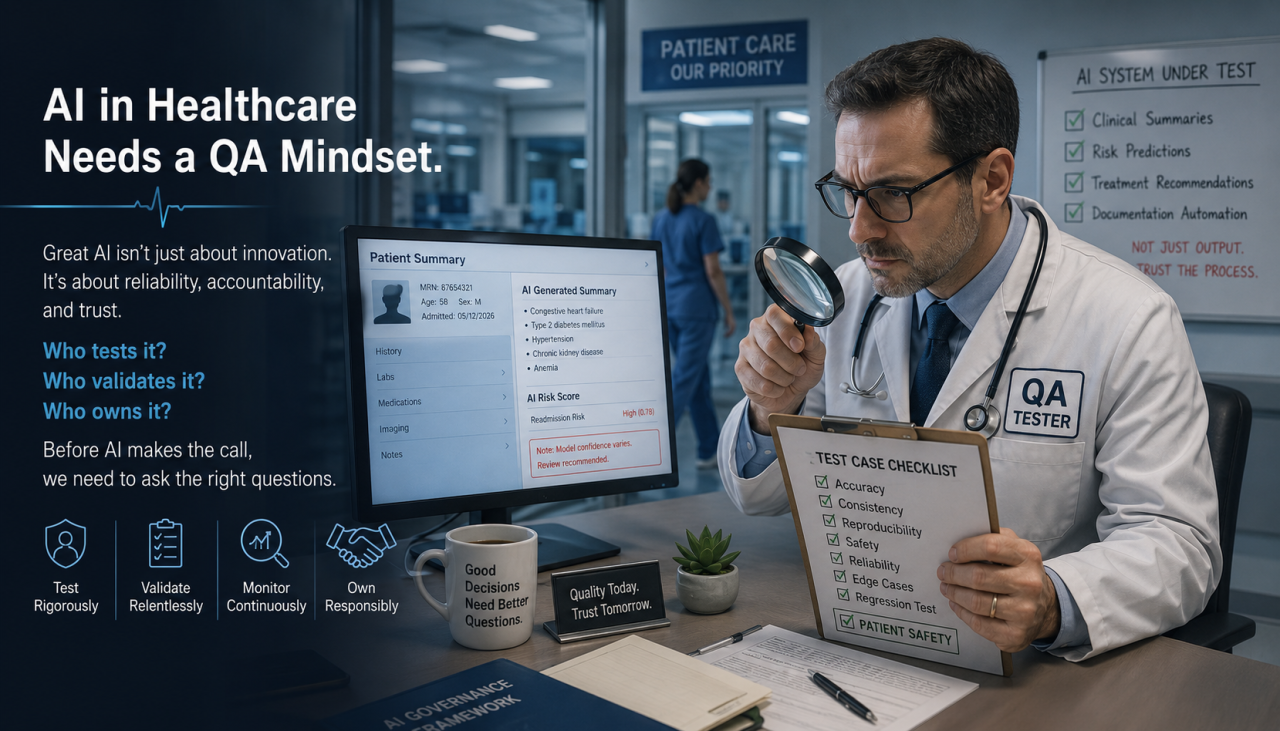
So why are we drifting toward a world where clinicians become the final quality assurance team for AI systems?
That seems backwards.
A lesson from Andrew Ng: build evaluation into the system
One of the ideas I appreciate most from Andrew Ng’s work on agentic AI is that intelligent systems should not rely primarily on end users to discover their failures.
He emphasizes something surprisingly simple: evaluation is not optional.
Modern AI systems should continuously test themselves, measure their performance, identify failure modes, and improve before the output reaches the user. Reflection loops, validation checks, and automated evaluations become part of the architecture—not an afterthought.
That principle resonates deeply with healthcare.
Imagine an ambient documentation system that automatically checks whether medications mentioned in the conversation appear consistently in the note, verifies that allergies were not omitted, flags contradictions between the transcript and the generated summary, and measures confidence levels before presenting the draft to the clinician.
Now the physician is reviewing a validated draft rather than acting as the primary defect detector.
That is a very different workflow.
And frankly, it is the direction the industry should be moving toward.
The Answer Isn’t More Human Checking—It’s Better AI Checking
The current debate assumes that the safest way to deploy AI is to make physicians review every word the software generates. That may be necessary today, but I don’t believe it is the long-term solution.
One of the most promising trends in AI is the move toward AI validating AI. Instead of relying solely on the end user to catch mistakes, modern AI systems are increasingly being designed as multi-stage workflows. One model generates the clinical note or patient summary, while another independently reviews it for omissions, hallucinations, inconsistencies, medication errors, contradictions, and unsupported conclusions before it ever reaches the physician.
This is the direction that AI researcher Andrew Ng has been advocating through agentic AI architectures. Rather than expecting a single model to be perfect, he recommends systems where AI agents continuously critique, verify, and improve each other’s work. In other words, the AI performs its own quality assurance before asking a human to make the final decision.
To me, this represents a fundamental shift in responsibility. Physicians should remain responsible for clinical judgment—not for functioning as the software vendor’s quality assurance team. The vendor’s responsibility should be to build AI systems that continuously test themselves, measure their own confidence, verify facts against source data, and flag uncertainty before presenting results to clinicians.
That is how we engineer safety in aviation, automotive systems, and medical devices. Healthcare AI should be no different. The future is not one AI replacing a physician. It is multiple AI systems continuously checking one another so that physicians can focus on what they do best—caring for patients.
Some vendors are starting to get this right
I was encouraged to see announcements from companies such as Abridge that focus not just on generating documentation, but on connecting AI outputs to evidence, clinical workflows, and downstream care processes.
Whether any single platform becomes the long-term winner is beside the point. What matters is the design philosophy.
The next generation of healthcare AI cannot be built around the assumption that “the doctor will catch it.” It has to be built around the assumption that the system itself must continuously verify, monitor, and explain its outputs.
That is the difference between a clever demo and a trustworthy clinical platform.
The accountability gap
Right now, I see an accountability gap emerging.
Vendors market AI as a productivity multiplier. Hospitals deploy it to reduce the documentation burden. Clinicians are encouraged to trust the workflow. But when an error occurs, the conversation often narrows to the individual provider who clicked “sign.”
That is not sustainable.
If AI is sufficiently capable to save clinicians hours of work, then it is sufficiently influential to require meaningful vendor accountability. We cannot celebrate AI’s autonomy on the way in and deny its impact on the way out.
Responsibility should be proportional to influence.
And AI systems are becoming increasingly influential in clinical workflows.
So Who Actually Owns the Mistake?
I don’t think there is a single owner.
And perhaps that is the biggest mindset shift we need.
In a traditional workflow, responsibility was relatively linear. A clinician documented care. A hospital maintained systems. A vendor provided software.
AI blurs those boundaries.
When an AI-generated note contains an error, several questions matter:
- Was the output clearly presented as AI-generated?
- Did the clinician have a reasonable opportunity to review it?
- Did the organization provide appropriate governance and training?
- Did the vendor validate the model adequately and monitor known failure modes?
- Were safeguards in place to detect unusual behavior?
Different answers may point to different responsibilities.
That is how mature industries handle complex systems. They analyze the chain, not just the final person who touched the keyboard.
Regulators and industry bodies
Responsible for defining standards so that accountability is not negotiated after an incident occurs.
Notice what is missing from that list: the idea that one person carries all the blame simply because they were the last human in the workflow.
Healthcare is already a team sport. AI does not change that. It simply adds a new teammate—one built from code, data, and algorithms.
A broader reflection
What fascinates me is that this debate is not really about documentation.
It is about trust.
Healthcare has spent decades building systems designed to reduce human error: checklists, medication barcoding, clinical decision support, and quality reporting. AI is the next chapter in that journey. But trust in healthcare is never granted automatically. It is earned through reliability, transparency, and accountability.
If vendors want AI to become an accepted participant in patient care, they must accept that accountability comes with that privilege.
Otherwise, we create a dangerous imbalance: clinicians carry the legal and ethical risk while vendors capture the productivity benefits.
That is neither fair nor sustainable.
The question I keep asking myself
As someone who has spent years building healthcare technology, I genuinely believe AI can reduce burnout, improve efficiency, and help clinicians focus more on patients and less on keyboards.
I am optimistic about where this technology is headed. But optimism should not prevent us from asking hard questions.
When an AI-generated note contains an error that changes clinical meaning, who should answer for it? When a model update introduces a new failure mode, who should detect it? When hospitals deploy AI at scale, who should prove that it is performing safely over time?
Those questions are no longer theoretical. They are operational questions. Governance questions. Leadership questions.
And the organizations that answer them well will shape the next decade of healthcare AI.
Closing thought
I’ll end where I began.
If the brakes fail, we investigate the brakes. We don’t automatically blame the person holding the steering wheel.
Healthcare AI deserves the same maturity of thinking.
Clinicians should remain accountable for clinical decisions. Vendors should remain accountable for the systems they build. Hospitals should remain accountable for how those systems are deployed and governed.
That is not about shifting blame. It is about aligning responsibility with reality. Because AI is no longer standing outside the clinic. It is sitting in the room, listening to the conversation, drafting the note, and increasingly influencing the workflow.
And when technology becomes part of care, accountability must become part of the design.
Curious to hear your perspective: As AI becomes embedded in clinical workflows, where do you think the line of accountability should be drawn? Should the clinician remain the final safety net, or should vendors bear a greater share of responsibility for AI-generated errors?
I suspect this conversation is just getting started.
Discover more from Sudhakar's Musings
Subscribe to get the latest posts sent to your email.